



Your support changes lives. Thank you!
Learn More
Authored by: Michelle Fernando, PhD, Natalie Hundt, PhD, and Joseph Tu, PhD
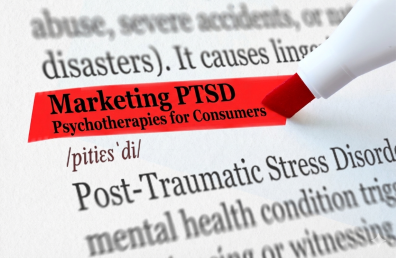
Despite being effective, PTSD treatments have a marketing problem
More providers are being trained in evidence-based psychotherapies (EBPs) for post-traumatic stress disorder (PTSD). Yet, about 42% of people with PTSD report they have not sought treatment. Potential consumers (i.e., those with PTSD) may be unaware that effective treatment exists or describe the names of PTSD EBPs negatively and inaccurately, which may discourage participation in these treatments. As a result, trauma-focused EBPs (and evidence-based practices widely, like exposure), remain underutilized in community mental health and within large healthcare systems, like the Veteran’s Health Administration. There is, thus, increasing attention to improve the way we market EBPs to clients.
Current marketing standards miss the mark
The most common form of “marketing” PTSD EBPs happens after a patient has already initiated care, often when treatment planning. Clinicians may provide psychoeducational pamphlets or handouts that are curated with close attention to research backing and clinical outcomes but do little to facilitate interest and motivation for treatment in consumers. For example, one study found that overly positive portrayals of recovery and symptom remission evoked skepticism and distrust in veterans with PTSD, who viewed PTSD as a lifelong illness. Current ways of pitching treatment options may not compellingly depict the content of treatment and how it fits the patient’s goals and style of learning, both of which tend to be important in determining consumer preference.
There are ways to make your PTSD EBP “pitch” more compelling
Clinicians have reported “pitching” PTSD EBPs through a few strategies.
- First, take your time: ditch rushed treatment pitches and opt for a shared decision-making approach (see this Toolkit).
- Second, focus beyond the facts: concrete information (number of sessions, effectiveness data, etc.) is helpful, but so is helping the patient more intuitively “see” themselves doing the treatment and deeply understand how it will personally help them.
- To do so, create an engaging discussion by using metaphors and short stories, sharing treatment successes, asking open-ended questions, speaking with joining language (“we’ll do this together”), and providing direct encouragement (“this treatment can work for you”). These strategies will help foster a collaborative environment and build buy-in for treatment.
- Fourth, consider changing clinical terms to accessible, hopeful names. Overly clinical terms likely won’t click with patients but changing prolonged exposure to “overcoming fears” or “approaching your fears,” or cognitive processing therapy to “helpful thinking” may be more memorable and digestible.
Is Direct to Consumer Marketing in our Future?
These strategies speak to the value of direct-to-consumer (DTC) marketing, a “pull” strategy most familiar to us in the form of commercials for medications. In fact, DTC advertising has historically increased prescribing and patient requests for psychotropic medications (e.g., “ask your doctor about...”). However, research on the impact of direct-to-consumer marketing for PTSD EBPs is in its infancy. It is essential for future research to focus on understanding the types of messages that resonate with Veterans.
Marketing literature uses many different strategies, such as using testimonials, using a compare/contrast message format to compare different options, or evoking strong emotions with compelling stories. However, most of the existing research on DTC marketing for therapy uses only one strategy, rather than comparing different strategies. Additionally, the modern marketing literature discusses how the most effective strategies may differ from person to person, reminding us that a personalized approach to pitching EBPs may remain most effective. Research has yet to identify any salient personal characteristics that may impact receptivity to different DTC marketing approaches to PTSD EBPs.
Until the research becomes clearer, in the meantime, we as clinicians can use some of these strategies to implement DTC marketing of our own and do our part to “sell” PTSD treatments more effectively to our clients.
Disclosure: This material is based upon work supported (or supported in part) by the Department of Veterans Affairs. The views expressed in this article are those of the authors and do not necessarily reflect the position or policy of the Department of Veterans Affairs or the United States government.
References
Lang, A. J., Hamblen, J. L., Holtzheimer, P., Kelly, U., Norman, S. B., Riggs, D., Schnurr, P. P. & Weichers, I. (2024). Journal of Traumatic Stress, 37(1), 19-34. https://doi.org/10.1002/jts.23013
Nobles, C. J., Valentine, S. E., Gerber, M. W., Shtasel, D. L., & Marques, L. (2016). Predictors of treatment utilization and unmet treatment need among individuals with posttraumatic stress disorder from a national sample. General Hospital Psychiatry, 43, 38-45. http://doi.org/10.1016/j.genhosppsych.2016.09.001
Larsen, S. E., Ranney, R. M., Matteo, R., Grubbs, K. M., & Hamblen, J. L. (2024). What’s in a treatment name? How people with posttraumatic stress disorder (PTSD) symptoms interpret and react to PTSD treatment names. Journal of Traumatic Stress, 38(1), 112-123. https://doi.org/10.1002/jts.23108
Wolitzky-Taylor, K., Zimmermann, M., Arch, J. J., Guzman, E. D., & Lagomasino, I. (2015). Has evidence-based psychosocial treatment for anxiety disorders permeated usual care in community mental health settings? Behaviour Research and Therapy, 72, 9-17. https://doi.org/10.1016/j.brat.2015.06.010
Shiner, B., Levis, M., Dufort, V. M., Patterson, O. V., Watts, B. V., DuVall, S. L., Russ, C. J., & Maguen, S. (2021). Improvements to PTSD quality metrics with natural language processing. Journal of Evaluation in Clinical Practice, 28(4), 520-530. https://doi.org/10.1111/jep.13587
Karlin, B. E., & Brenner, L. A. (2020). Improving engagement in evidence-based psychological treatments among Veterans: Direct-to-consumer outreach and pretreatment shared decision-making. Clinical Psychology: Science and Practice, 27(4), Article e12344. https://doi.org/10.1111/cpsp.12344
Kehle-Forbes, S., Gerould, H., Polusny, M. A., Sayer, N. A., & Partin, M. R. (2022). “It leaves me very skeptical” messaging in marketing prolonged exposure and cognitive processing therapy to veterans with PTSD. Psychological Trauma: Theory, Research, Practice, and Policy, 14(5), 849-852. https://doi.org/10.1037/tra0000550
Larsen, S. E., Ranney, R. M., Matteo, R. A., Grubbs, K. M., & Hamblen, J. L. (2026). Why might people consider certain posttraumatic stress disorder treatment options and not others? Psychological Trauma: Theory, Research, Practice, and Policy. Advance online publication. https://doi.org/10.1037/tra0002118
Hooyer, K., Hamblen, J., Kehle-Forbes, S. M., & Larsen, S. E. (2024). “Pitching” posttraumatic stress disorder treatment: A qualitative study of how providers discuss evidence-based psychotherapies with patients. Journal of Traumatic Stress, 37(6), 901-912. https://doi.org/10.1002/jts.23058
Chandra, S., Verma, S., Lim, W. M., Kumar, S., & Donthu, N. (2022). Personalization in personalized marketing: Trends and ways forward. Psychology & Marketing, 39(8), 1529-1562. https://doi.org/10.1002/mar.21670









ADAA Blog Content and Blog Comments Policy
ADAA provides this Website blogs for the benefit of its members and the public. The content, view and opinions published in Blogs written by our personnel or contributors – or from links or posts on the Website from other sources - belong solely to their respective authors and do not necessarily reflect the views of ADAA, its members, management or employees. Any comments or opinions expressed are those of their respective contributors only. Please remember that the open and real-time nature of the comments posted to these venues makes it is impossible for ADAA to confirm the validity of any content posted, and though we reserve the right to review and edit or delete any such comment, we do not guarantee that we will monitor or review it. As such, we are not responsible for any messages posted or the consequences of following any advice offered within such posts. If you find any posts in these posts/comments to be offensive, inaccurate or objectionable, please contact us via email at [email protected] and reference the relevant content. If we determine that removal of a post or posts is necessary, we will make reasonable efforts to do so in a timely manner.
ADAA expressly disclaims responsibility for and liabilities resulting from, any information or communications from and between users of ADAA’s blog post commenting features. Users acknowledge and agree that they may be individually liable for anything they communicate using ADAA’s blogs, including but not limited to defamatory, discriminatory, false or unauthorized information. Users are cautioned that they are responsible for complying with the requirements of applicable copyright and trademark laws and regulations. By submitting a response, comment or content, you agree that such submission is non-confidential for all purposes. Any submission to this Website will be deemed and remain the property of ADAA.
The ADAA blogs are forums for individuals to share their opinions, experiences and thoughts related to mental illness. ADAA wants to ensure the integrity of this service and therefore, use of this service is limited to participants who agree to adhere to the following guidelines:
1. Refrain from transmitting any message, information, data, or text that is unlawful, threatening, abusive, harassing, defamatory, vulgar, obscene, that may be invasive of another 's privacy, hateful, or bashing communications - especially those aimed at gender, race, color, sexual orientation, national origin, religious views or disability.
Please note that there is a review process whereby all comments posted to blog posts and webinars are reviewed by ADAA staff to determine appropriateness before comments are posted. ADAA reserves the right to remove or edit a post containing offensive material as defined by ADAA.
ADAA reserves the right to remove or edit posts that contain explicit, obscene, offensive, or vulgar language. Similarly, posts that contain any graphic files will be removed immediately upon notice.
2. Refrain from posting or transmitting any unsolicited, promotional materials, "junk mail," "spam," "chain mail," "pyramid schemes" or any other form of solicitation. ADAA reserves the right to delete these posts immediately upon notice.
3. ADAA invites and encourages a healthy exchange of opinions. If you disagree with a participant 's post or opinion and wish to challenge it, do so with respect. The real objective of the ADAA blog post commenting function is to promote discussion and understanding, not to convince others that your opinion is "right." Name calling, insults, and personal attacks are not appropriate and will not be tolerated. ADAA will remove these posts immediately upon notice.
4. ADAA promotes privacy and encourages participants to keep personal information such as address and telephone number from being posted. Similarly, do not ask for personal information from other participants. Any comments that ask for telephone, address, e-mail, surveys and research studies will not be approved for posting.
5. Participants should be aware that the opinions, beliefs and statements on blog posts do not necessarily represent the opinions and beliefs of ADAA. Participants also agree that ADAA is not to be held liable for any loss or injury caused, in whole or in part, by sponsorship of blog post commenting. Participants also agree that ADAA reserves the right to report any suspicions of harm to self or others as evidenced by participant posts.