
Your support changes lives. Thank you!
Learn More
Discover a structured framework for assessing patients’ AI chatbot use, including its frequency,…
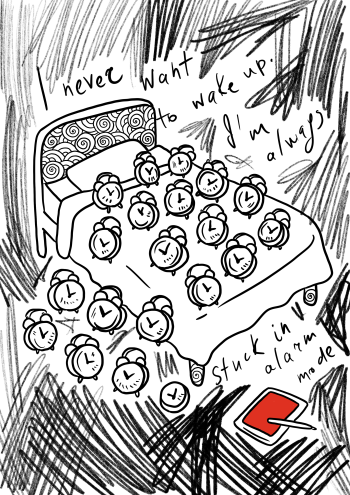
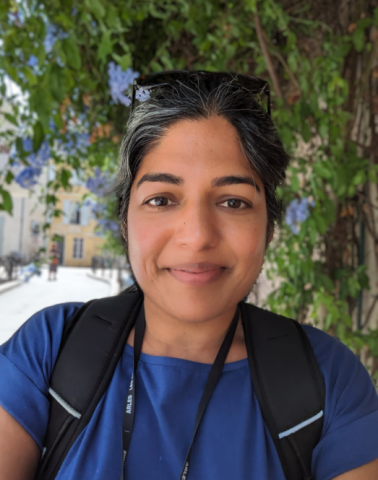
I’m an illustrator and the mother of two little boys. I also live with obsessive–compulsive disorder (OCD) and anxiety — a mix that turns everyday life into a mix of comedy and chaos. Sometimes I can’t start the washing machine because I have to check several times if I set the temperature with my right hand. Left hand? Disaster. Right hand? Safe… for now. And yet, despite all this, I fell in love, got married, had children, and built a career.
OCD started early. As a child, I went to bed fully dressed with my school backpack strapped on, convinced it would guarantee good grades. In college, I sometimes returned home just to put on my sneakers in the “correct” order — right first, then left — because my brain insisted on it. When I realized everyone else lived without these rituals, I hid my habits, even from family, thinking no one could understand.
Adulthood brought new challenges. Dating was exhausting: if a text didn’t arrive at a precise hour, panic would take over. My career wasn’t immune either. Once, I was late for a book presentation I had illustrated because I ran back in a taxi to close the door with the “correct” hand. I collapsed afterward with a fever of 104°F — exhaustion courtesy of OCD. Life pushed me further: a tick bite in Ukraine led to Lyme disease, forty IV drips, and weeks of recovery. Yet love and family persisted. I married someone who accepted me as I am, moved abroad, endured two pregnancy losses, and finally gave birth to two healthy sons. I even illustrated a project during labor, terrified of missing a deadline.
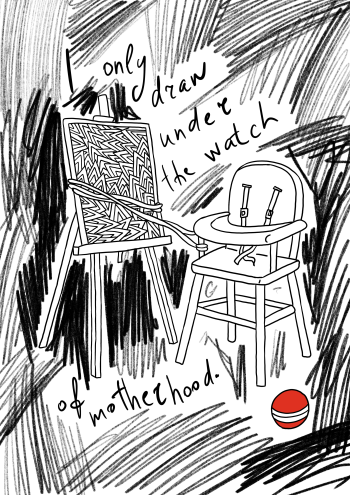
By thirty-eight, anxiety had reached its peak. War seemed to follow me everywhere — my mother and sister under shelling in Ukraine, my sons and I sprinting to bomb shelters in Israel. I finally saw a psychiatrist. He turned out to be a left-leaning political thinker who loved debating world affairs for hours, which was both exhausting and strangely comforting. Anafranil didn’t work for me physically, so I started fluoxetine. It’s a tricky companion: sometimes it fuels creativity, sending me from “I’ll paint a masterpiece tomorrow and get into the Louvre!” to “I can’t even get up to use the bathroom.” But at least it stopped me from throwing my clothes into the trash in panic. Small victories.
Through all of this, I discovered that art is more than work; it’s survival. Painting and illustrating became ways to structure the chaos in my head, give my anxiety a voice, and create spaces where I could breathe. It’s in this space — my “Mental Room” — where my fears, obsessions, and creativity coexist, and where I can transform struggle into something others might recognize, relate to, and maybe even find hope in.
I simply cannot stop drawing — it has been my personal art therapy for twenty-two years. For over two decades, I have worked as an illustrator, and drawing has become the core of my life, my survival, and my identity. Every day, I enter my “Mental Room,” a private space in paper and pencil where my thoughts, fears, and obsessions take form and order.
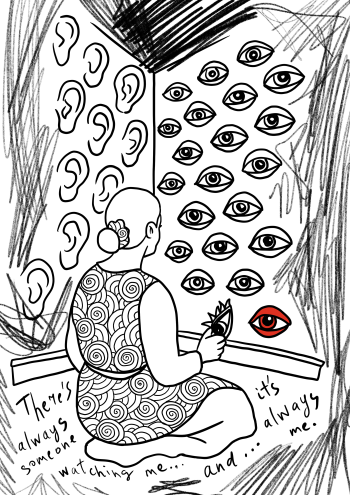
In this room, I write and illustrate one forbidden truth each day. The pressure and chaos of the pencil on paper let me trace the tension inside me, turning anxiety into something tangible. Some days the lines are frantic, jagged, almost violent; other days they are soft, deliberate, revealing a rare moment of calm. It’s a dialogue with myself — a way to understand what I cannot always speak aloud.
For me, art is not just a profession; it is my lifeline, my witness, and my proof that life with OCD and anxiety can still be rich, meaningful, and, at times, even beautiful.
I know how isolating anxiety and OCD can feel. I chose to share my story with ADAA because:
ADAA is a place where personal stories can turn pain into connection, and that is exactly what I want my voice to do.


Take Action
Find Help. Learn More. Support ADAA.