Your support changes lives. Thank you!
Learn More
Discover a structured framework for assessing patients’ AI chatbot use, including its frequency,…
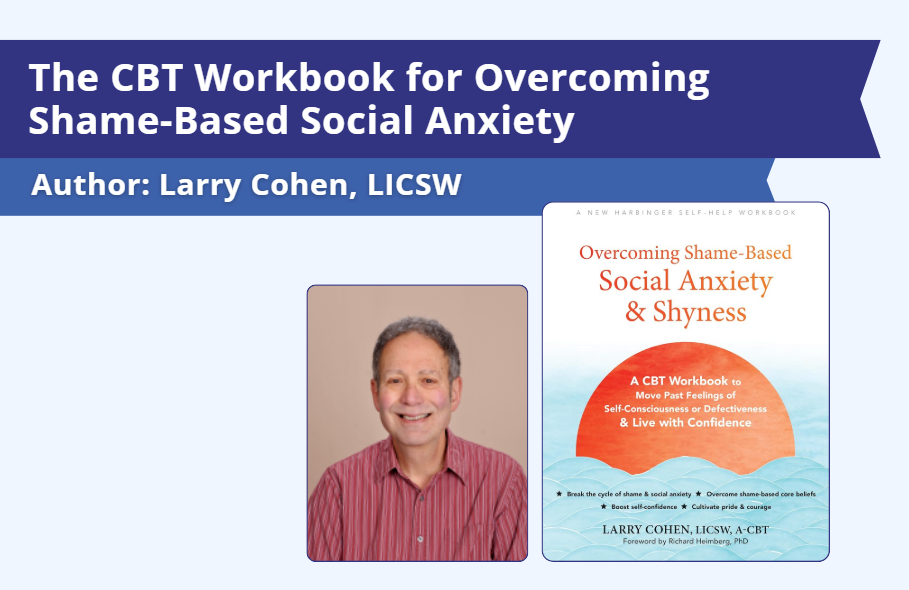
Authored by: Larry Cohen, LICSW, A-CBT and Grace Berman, LCSW
Social anxiety disorder is one of the most common anxiety disorders—and for many people, it is driven not just by fear of judgment, but by shame.
Watch the free ADAA webinar on social anxiety, The CBT Workbook for Overcoming Shame-Based Social Anxiety: Live Q&A with the Author, featuring ADAA member and author Larry Cohen, LICSW—clinician, researcher, and co-founder of the National Social Anxiety Center—in conversation with ADAA member (moderator) Grace Berman, LCSW of the The Ross Center. Discover simple, practical, and evidence-based strategies to manage your social anxiety—from an expert you can trust. These tools are easy to use, and you can start applying them today to feel more confident in social situations.
Below are questions asked during the webinar's live Q&A by participants in our incredible audience. Read the answers from social anxiety expert, Larry Cohen, LICSW.
Yes. Most people benefit from structured self-help programs that include behavioral experiments and worksheets. Progress tends to be stronger when paired with support from a therapist, support group, or trusted accountability partner.
Social anxiety doesn’t typically worsen suddenly, but without treatment it usually leads to increased avoidance and reduced quality of life.
No. Introversion refers to a preference for fewer and quieter interpersonal interactions. Social anxiety involves fear, avoidance, and shame. Introverts and extroverts alike can experience social anxiety disorder.
Yes — telehealth CBT can be just as effective as in-person treatment for most individuals, though in-person work may offer more live practice opportunities.
Social anxiety disorder is not a personal failing. When shame is addressed directly and beliefs are tested through real-world experiences, people can reduce anxiety, strengthen self-worth, and build more meaningful social connections.
This blog highlights important takeaways from the webinar, including Cohen's responses to real questions from participants seeking help for social anxiety.
At the core of shame-based social anxiety is the belief that there is something fundamentally wrong or unacceptable about oneself. People are not just afraid of feeling anxious — they fear what those internal experiences suggest about their identity or worth.
To learn more about the nature and symptoms of social anxiety, visit the ADAA overview of social anxiety disorder.
What Is Social Anxiety Disorder?
Social anxiety disorder is an intense and persistent fear of social evaluation. What sets it apart from other phobias is its connection to self-worth.
Shame appears in two common forms:
In both cases, the concern is not just anxiety itself but what that anxiety seems to say about who you are.
The most effective treatment for social anxiety disorder is Cognitive Behavioral Therapy (CBT), which teaches people how to challenge unhelpful thoughts, test beliefs in the real world, and build confidence.
A central tool in CBT is behavioral experiments, which help people test feared beliefs, such as:
By trying real interactions and seeing the outcomes, individuals begin to collect evidence that challenges these assumptions and reduces shame.
Learn more about CBT for social anxiety and other evidence-based treatment options from ADAA.
People with social anxiety usually use safety-seeking strategies to feel more in control — for example:
While these behaviors may feel protective, they actually increase self-focus and interrupt natural social engagement. Over time, they reinforce the belief that “I’m bad socially,” even when their self-perception isn’t an accurate reflection of real interactions.
It’s important to acknowledge that judgment does occur — and some people face greater social scrutiny due to disability, race, gender identity, sexual orientation, or other societal biases.
CBT doesn’t deny this reality. Instead, it helps people:
This reframing is a powerful tool for reducing the influence of shame.
If you’re ready to seek support, ADAA’s Find Your Therapist Directory connects you with licensed mental health professionals who treat anxiety disorders including social anxiety.
Personal Stories:
Blogs:
Webinars:
Videos & Podcasts:
Books by ADAA Member Professionals



Take Action
Find Help. Learn More. Support ADAA.







ADAA Blog Content and Blog Comments Policy
ADAA provides this Website blogs for the benefit of its members and the public. The content, view and opinions published in Blogs written by our personnel or contributors – or from links or posts on the Website from other sources - belong solely to their respective authors and do not necessarily reflect the views of ADAA, its members, management or employees. Any comments or opinions expressed are those of their respective contributors only. Please remember that the open and real-time nature of the comments posted to these venues makes it is impossible for ADAA to confirm the validity of any content posted, and though we reserve the right to review and edit or delete any such comment, we do not guarantee that we will monitor or review it. As such, we are not responsible for any messages posted or the consequences of following any advice offered within such posts. If you find any posts in these posts/comments to be offensive, inaccurate or objectionable, please contact us via email at [email protected] and reference the relevant content. If we determine that removal of a post or posts is necessary, we will make reasonable efforts to do so in a timely manner.
ADAA expressly disclaims responsibility for and liabilities resulting from, any information or communications from and between users of ADAA’s blog post commenting features. Users acknowledge and agree that they may be individually liable for anything they communicate using ADAA’s blogs, including but not limited to defamatory, discriminatory, false or unauthorized information. Users are cautioned that they are responsible for complying with the requirements of applicable copyright and trademark laws and regulations. By submitting a response, comment or content, you agree that such submission is non-confidential for all purposes. Any submission to this Website will be deemed and remain the property of ADAA.
The ADAA blogs are forums for individuals to share their opinions, experiences and thoughts related to mental illness. ADAA wants to ensure the integrity of this service and therefore, use of this service is limited to participants who agree to adhere to the following guidelines:
1. Refrain from transmitting any message, information, data, or text that is unlawful, threatening, abusive, harassing, defamatory, vulgar, obscene, that may be invasive of another 's privacy, hateful, or bashing communications - especially those aimed at gender, race, color, sexual orientation, national origin, religious views or disability.
Please note that there is a review process whereby all comments posted to blog posts and webinars are reviewed by ADAA staff to determine appropriateness before comments are posted. ADAA reserves the right to remove or edit a post containing offensive material as defined by ADAA.
ADAA reserves the right to remove or edit posts that contain explicit, obscene, offensive, or vulgar language. Similarly, posts that contain any graphic files will be removed immediately upon notice.
2. Refrain from posting or transmitting any unsolicited, promotional materials, "junk mail," "spam," "chain mail," "pyramid schemes" or any other form of solicitation. ADAA reserves the right to delete these posts immediately upon notice.
3. ADAA invites and encourages a healthy exchange of opinions. If you disagree with a participant 's post or opinion and wish to challenge it, do so with respect. The real objective of the ADAA blog post commenting function is to promote discussion and understanding, not to convince others that your opinion is "right." Name calling, insults, and personal attacks are not appropriate and will not be tolerated. ADAA will remove these posts immediately upon notice.
4. ADAA promotes privacy and encourages participants to keep personal information such as address and telephone number from being posted. Similarly, do not ask for personal information from other participants. Any comments that ask for telephone, address, e-mail, surveys and research studies will not be approved for posting.
5. Participants should be aware that the opinions, beliefs and statements on blog posts do not necessarily represent the opinions and beliefs of ADAA. Participants also agree that ADAA is not to be held liable for any loss or injury caused, in whole or in part, by sponsorship of blog post commenting. Participants also agree that ADAA reserves the right to report any suspicions of harm to self or others as evidenced by participant posts.