
Your support changes lives. Thank you!
Learn More
02.26.2025


Authored by: Vanessa Luchtan Finkelman, PsyD
If Hedda Bolgar had a business card, it would read: “Psychoanalyst. Psychotherapist. Mentor. Educator. Supervisor. Social Activist. Feminist. Centenarian. Hostess. Friend.” The typography could be graffiti, spray-painted to represent revolutionary angst and the pursuit of social justice. The design would be delicate with a floral border reminiscent of the gardens at her Brentwood, California abode, which housed her private practice, countless social gatherings, and scholarly seminars and salons. Bolgar was extraordinary – multifaceted, optimistic, progressive, smart, kind, supportive, generous, and beloved. Working until the age of 103, she made an immeasurable impact, enriching the lives of her patients, students, and society at large through her vast efforts to connect psychoanalysis with advocacy.
Born in Zurich, Switzerland, on August 19, 1909, Bolgar spent her childhood in Hungary before moving to Vienna. She was the only child of historian and freedom fighter, Elek Bolgar, and early female journalist and war correspondent, Elza Stern. Given her background, her penchant for activism feels predetermined. Her ninth birthday party was canceled so her parents could join a civil uprising in Hungary; her ensuing protest was met with sarcastic disapproval. With age, Bolgar expressed increasing appreciation for her parents. The principles with which they raised her undoubtedly informed her work and worldview.
As a result, Bolgar always envisioned herself having a career. Though she anticipated journalism, she gravitated to psychology, attending lectures by Freud and graduating with her doctorate from the University of Vienna in 1934. In the mid-1930s, she collaborated with Liselotte Fischer to create the Little World Test, a nonverbal projective measure. Having published anti-Nazi material, Bolgar was forced to flee Vienna the day Hitler invaded Austria in 1938. While her future husband, Herbert Bekker, remained in Austria for two years, she continued her psychoanalytic training and teaching in Chicago. She was the first non-medical graduate of the Chicago Psychoanalytic Institute, and the first woman in the psychology department at the University of Chicago. In 1940, Herbert joined her in the United States, and in 1954, they moved to Los Angeles. They were married for 33 years until Herbert died in 1973.
With a career spanning nearly eight decades, Bolgar touched countless lives and contributed to numerous programs and initiatives that advanced psychoanalytic training and treatment while aligning psychoanalysis with social justice. For almost 20 years, she served as chief psychologist and director of postdoctoral training at Cedars-Sinai Medical Center. She helped found and co-found several notable institutions, including the California School of Professional Psychology, the Los Angeles Institute & Society for Psychoanalytic Studies, and Wright Institute Los Angeles (WILA). She once said, “I started a lot of things at 65.” A reminder to all that it is never too late to begin.
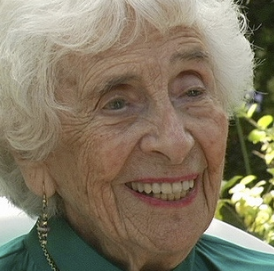
Later in life, Bolgar's interests in political activism and psychoanalysis expanded to include aging and feminism. She was interviewed for a documentary titled The Beauty of Aging, which captured her warmth and approachability on film. Her segment shows her 103rd birthday party at home with friends and chocolate cake. Bolgar shared that when asked about her favorite age, her response was always “now.” She stated that she has met each stage of life with curiosity and openness to change, which feels akin to work as a psychologist – a profession she described as “exceedingly exciting.” She referred to aging as allowing her to push boundaries and inspire activism of her colleagues. Elsewhere, she spoke against the blank screen, arguing that an analyst’s personality and life experience inevitably shape and enrich their perception and interpretation. Bolgar appreciated the evolution of psychoanalysis away from dogmatic tenacity and advocated for a life of varied experiences and relationships.
At 95 years old, Bolgar organized her final large project: a three-day conference that bridged psychoanalysis with social justice. In 2011, at 102 years old, she was one of two individuals to receive the “Outstanding Oldest Worker” award in Washington, D.C. At the time, she was still working four days a week and preparing a new course. She maintained that schedule, plus social engagements, until three weeks before her passing on May 13, 2013. During her trip to D.C., she conducted her scheduled sessions by phone, and soon after, she delivered a two-hour lecture without notes at a conference. Bolgar's only complaint about aging was the limitation it imposed on accepting new cases. Her dedication to helping others defined her remarkable career. In her award acceptance speech, she spoke about “dignity and purpose in work” and “grace in aging” – a perfect reflection of the legacy she left behind.
References:
Take Action
Find Help. Learn More. Support ADAA.











ADAA Blog Content and Blog Comments Policy
ADAA provides this Website blogs for the benefit of its members and the public. The content, view and opinions published in Blogs written by our personnel or contributors – or from links or posts on the Website from other sources - belong solely to their respective authors and do not necessarily reflect the views of ADAA, its members, management or employees. Any comments or opinions expressed are those of their respective contributors only. Please remember that the open and real-time nature of the comments posted to these venues makes it is impossible for ADAA to confirm the validity of any content posted, and though we reserve the right to review and edit or delete any such comment, we do not guarantee that we will monitor or review it. As such, we are not responsible for any messages posted or the consequences of following any advice offered within such posts. If you find any posts in these posts/comments to be offensive, inaccurate or objectionable, please contact us via email at [email protected] and reference the relevant content. If we determine that removal of a post or posts is necessary, we will make reasonable efforts to do so in a timely manner.
ADAA expressly disclaims responsibility for and liabilities resulting from, any information or communications from and between users of ADAA’s blog post commenting features. Users acknowledge and agree that they may be individually liable for anything they communicate using ADAA’s blogs, including but not limited to defamatory, discriminatory, false or unauthorized information. Users are cautioned that they are responsible for complying with the requirements of applicable copyright and trademark laws and regulations. By submitting a response, comment or content, you agree that such submission is non-confidential for all purposes. Any submission to this Website will be deemed and remain the property of ADAA.
The ADAA blogs are forums for individuals to share their opinions, experiences and thoughts related to mental illness. ADAA wants to ensure the integrity of this service and therefore, use of this service is limited to participants who agree to adhere to the following guidelines:
1. Refrain from transmitting any message, information, data, or text that is unlawful, threatening, abusive, harassing, defamatory, vulgar, obscene, that may be invasive of another 's privacy, hateful, or bashing communications - especially those aimed at gender, race, color, sexual orientation, national origin, religious views or disability.
Please note that there is a review process whereby all comments posted to blog posts and webinars are reviewed by ADAA staff to determine appropriateness before comments are posted. ADAA reserves the right to remove or edit a post containing offensive material as defined by ADAA.
ADAA reserves the right to remove or edit posts that contain explicit, obscene, offensive, or vulgar language. Similarly, posts that contain any graphic files will be removed immediately upon notice.
2. Refrain from posting or transmitting any unsolicited, promotional materials, "junk mail," "spam," "chain mail," "pyramid schemes" or any other form of solicitation. ADAA reserves the right to delete these posts immediately upon notice.
3. ADAA invites and encourages a healthy exchange of opinions. If you disagree with a participant 's post or opinion and wish to challenge it, do so with respect. The real objective of the ADAA blog post commenting function is to promote discussion and understanding, not to convince others that your opinion is "right." Name calling, insults, and personal attacks are not appropriate and will not be tolerated. ADAA will remove these posts immediately upon notice.
4. ADAA promotes privacy and encourages participants to keep personal information such as address and telephone number from being posted. Similarly, do not ask for personal information from other participants. Any comments that ask for telephone, address, e-mail, surveys and research studies will not be approved for posting.
5. Participants should be aware that the opinions, beliefs and statements on blog posts do not necessarily represent the opinions and beliefs of ADAA. Participants also agree that ADAA is not to be held liable for any loss or injury caused, in whole or in part, by sponsorship of blog post commenting. Participants also agree that ADAA reserves the right to report any suspicions of harm to self or others as evidenced by participant posts.