Your support changes lives. Thank you!
Learn More
While fitness can initially serve as a healthy and disciplined outlet for young men, the constant…
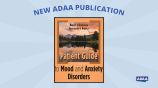
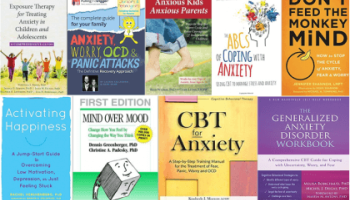
Every quarter ADAA interviews three members for a blog that showcases new books by our esteemed experts. Our series – “In Conversation With ADAA Member Authors” – is a wonderful way to highlight our members' expertise and provide not only a brief synopsis of their books' focus areas but gives members a chance to relay in their own words what’s special or important about their respective publication(s).
We hope you will take advantage of this special member benefit and let us know if you would like to highlight a new book in a future blog by reaching out to [email protected]. And please read and enjoy previous quarterly blogs featuring ADAA’s members’ books and expertise:
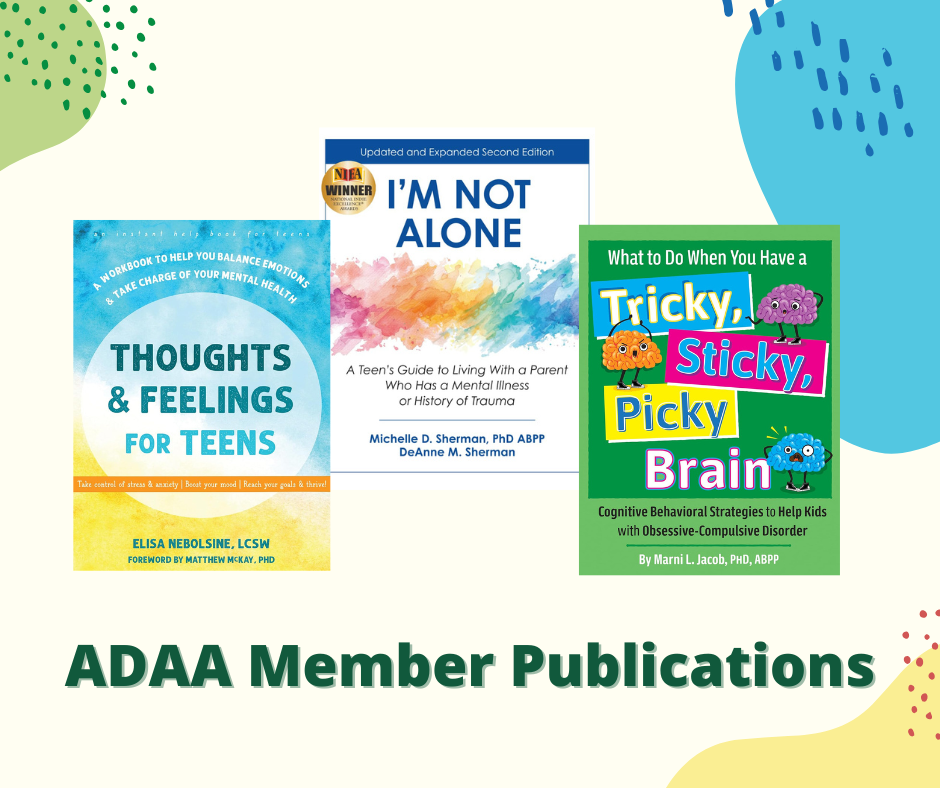
Discover resources to support children and teens navigating mental health challenges in our winter 2026 member book blog, featuring: I’m Not Alone: A Teen’s Guide to Living with a Parent Who Has a Mental Illness or History of Trauma (2nd Edition) by Michelle Sherman, PhD, LP, ABPP and DeAnne Sherman; Thoughts and Feelings for Teens: A Workbook to Help You Balance Emotions and Take Charge of Your Mental Health by Elisa Nebolsine, LCSW; and What to Do When You Have a Tricky, Sticky, Picky Brain: Cognitive Behavioral Strategies to Help Kids with Obsessive-Compulsive Disorder by Marni L. Jacob, PhD, ABPP, with a foreword by Eric Storch, PhD.
Discover more about Cognitive Behavioral Therapy and how it can help with fears, social anxiety, and pediatric OCD. Learn more in our fall 2025 member book blog, featuring: Overcoming Shame-Based Social Anxiety & Shyness: A CBT Workbook to Move Past Feelings of Self-Consciousness or Defectiveness and Live with Confidence by Larry Cohen, LICSW, A-CBT, The Body-Based Obsessions Workbook: CBT Skills to Manage Anxiety and Intrusive Thoughts About Your Body and Brain by Molly Bradley Schiffer, LCPC with a foreword by ADAA member Jon Hershfield, MFT, and Treatment of OCD in Children and Adolescents: A Cognitive Behavioral Therapy Manual (Professional's Kit, Third Edition) by Aureen Pinto Wagner, PhD.
Learn skills to cope and heal from racial and cultural stress, strategies to live a full life with chronic illness, and advice on how to love someone with trauma or a mental illness. Our summer 2025 member book blog features: Empower Yourself Against Racial and Cultural Stress: Using Skills from the REACH Program to Cope, Heal, and Thrive by Ryan DeLapp, PhD, You Are More Than Your Body: 30+ Evidence-Based Strategies for Living Well with Chronic Illness--By a Clinical Therapist Living with Cerebral Palsy by Jennifer Caspari, PhD, and Loving Someone w/a Mental Illness or History of Trauma: Skills, Hope, Strength for Your Journey by Michelle Sherman, PhD, LP ABPP.
Member books cover an array of important mental health topics. Discover more about grief, OCD, and faith and emotions in our spring 2025 member book blog, featuring: The Grieving Body: How the Stress of Loss Can Be an Opportunity for Healing by Mary-Frances O'Connor, PhD, Resolving OCD: Advanced Strategies for Overcoming Obsessional Doubts (Volume 2) by Frederick Aardema, PhD, and Mastering Our Emotions: Biblical Principles for Emotional Health by L. Kevin Chapman, PhD.
Learn more about panic disorders, agoraphobia, and anxiety in both children and adults in our winter 2025 member book blog, featuring: Panic Disorder and Agoraphobia (Vol 55) - Advances in Psychotherapy Evidence-Based Practice by Simon Rego, PsyD, ABPP, A-CBT, The Anxiety Busting Workbook for Kids: Fun CBT Activities to Squash Your Fears and Worries by Debra Kissen, PhD, MHSA, and This is What Anxiety Looks Like: Relatable Stories, Targeted Solutions, and CBT Skills for Lasting Relief by David A. Clark, PhD.
Discover more about obsessions and compulsions, eating disorders and intrusive thoughts from ADAA member author books in our fall 2024 blog, featuring; Comorbid Eating Disorders and Obsessive-Compulsive Disorder: A Clinician's Guide to Challenges in Treatment by Jenna DiLossi, PsyD, ABPP and Melissa Harrison, MA, LPC, The Compulsive Reassurance Seeking Workbook: CBT Skills to Help You Live with Confidence and Break the Cycle of Obsessive-Compulsive Disorder by Amanda Petrik-Gardner, LCPC, and Hello Baby, Goodbye Intrusive Thoughts: Stop the Spiral of Anxiety and OCD to Reclaim Wellness on Your Motherhood Journey by Jenny Yip, PsyD, ABPP
Learn about happiness, self-awareness, and resilience from ADAA member author books in our summer 2024 blog, featuring; The Way I See It by Ashley Smith, PhD, When a Loved One Won’t Seek Mental Health Treatment by Melanie VanDyke, PhD, and C. Alec Pollard, PhD, and The Stoicism Workbook by R. Trent Codd, III, EdS, and Scott Waltman, PsyD, ABPP.
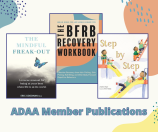
Mindful freak-outs, recovery from body-focused repetitive behaviors (BFRBs) and a children’s book on dealing with childhood anxiety are the subjects for this spring 2024 blog featuring: The Mindful Freak-Out by Eric Goodman, PhD, Step by Step by Kathryn Boger, PhD, ABPP, and The BFRB Recovery Workbook by Marla Deibler, PsyD, ABPP and Renae Reinardy, PsyD.
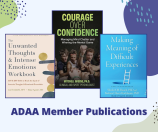
Mental health fitness and exercise of the mind are just as important as physical and body strength. Read how these member books show us that emotional fitness, winning the mental game and exercising a sensible treatment balance can help: The Unwanted Thoughts & Intense Emotions Workbook by Jon Hershfield, MFT, Courage Over Confidence by Mitchell Greene, PhD, and Making Meaning of Difficult Experiences by Sheila Rauch, PhD, and Barbara Rothbaum, PhD.
Anxiety in teens, social anxiety, and nine tools to actually thrive with anxiety give this member books blog useful skills, professional help and practical advice for those struggling with different types of anxiety: The Action Mindset Workbook for Teens by Mary Karapetian Alvord, PhD, CBT for Social Anxiety by Stefan Hofmann, PhD, and Thriving with Anxiety by David H. Rosmarin, PhD.
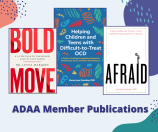
Fear is a part of life. But fear often takes over and causes debilitating anxiety, avoidance, and even obsessive-compulsive behaviors. In this blog, three member books help us put fear into perspective, transform anxiety into power and address challenging OCD subtypes in youth: Afraid by Arash Javanbakht, MD, Bold Move by Luana Marques, PhD, and Helping Children & Teens with Difficult-to-Treat OCD by Karen Cassiday, PhD, ACT.



Take Action
Find Help. Learn More. Support ADAA.




ADAA Blog Content and Blog Comments Policy
ADAA provides this Website blogs for the benefit of its members and the public. The content, view and opinions published in Blogs written by our personnel or contributors – or from links or posts on the Website from other sources - belong solely to their respective authors and do not necessarily reflect the views of ADAA, its members, management or employees. Any comments or opinions expressed are those of their respective contributors only. Please remember that the open and real-time nature of the comments posted to these venues makes it is impossible for ADAA to confirm the validity of any content posted, and though we reserve the right to review and edit or delete any such comment, we do not guarantee that we will monitor or review it. As such, we are not responsible for any messages posted or the consequences of following any advice offered within such posts. If you find any posts in these posts/comments to be offensive, inaccurate or objectionable, please contact us via email at [email protected] and reference the relevant content. If we determine that removal of a post or posts is necessary, we will make reasonable efforts to do so in a timely manner.
ADAA expressly disclaims responsibility for and liabilities resulting from, any information or communications from and between users of ADAA’s blog post commenting features. Users acknowledge and agree that they may be individually liable for anything they communicate using ADAA’s blogs, including but not limited to defamatory, discriminatory, false or unauthorized information. Users are cautioned that they are responsible for complying with the requirements of applicable copyright and trademark laws and regulations. By submitting a response, comment or content, you agree that such submission is non-confidential for all purposes. Any submission to this Website will be deemed and remain the property of ADAA.
The ADAA blogs are forums for individuals to share their opinions, experiences and thoughts related to mental illness. ADAA wants to ensure the integrity of this service and therefore, use of this service is limited to participants who agree to adhere to the following guidelines:
1. Refrain from transmitting any message, information, data, or text that is unlawful, threatening, abusive, harassing, defamatory, vulgar, obscene, that may be invasive of another 's privacy, hateful, or bashing communications - especially those aimed at gender, race, color, sexual orientation, national origin, religious views or disability.
Please note that there is a review process whereby all comments posted to blog posts and webinars are reviewed by ADAA staff to determine appropriateness before comments are posted. ADAA reserves the right to remove or edit a post containing offensive material as defined by ADAA.
ADAA reserves the right to remove or edit posts that contain explicit, obscene, offensive, or vulgar language. Similarly, posts that contain any graphic files will be removed immediately upon notice.
2. Refrain from posting or transmitting any unsolicited, promotional materials, "junk mail," "spam," "chain mail," "pyramid schemes" or any other form of solicitation. ADAA reserves the right to delete these posts immediately upon notice.
3. ADAA invites and encourages a healthy exchange of opinions. If you disagree with a participant 's post or opinion and wish to challenge it, do so with respect. The real objective of the ADAA blog post commenting function is to promote discussion and understanding, not to convince others that your opinion is "right." Name calling, insults, and personal attacks are not appropriate and will not be tolerated. ADAA will remove these posts immediately upon notice.
4. ADAA promotes privacy and encourages participants to keep personal information such as address and telephone number from being posted. Similarly, do not ask for personal information from other participants. Any comments that ask for telephone, address, e-mail, surveys and research studies will not be approved for posting.
5. Participants should be aware that the opinions, beliefs and statements on blog posts do not necessarily represent the opinions and beliefs of ADAA. Participants also agree that ADAA is not to be held liable for any loss or injury caused, in whole or in part, by sponsorship of blog post commenting. Participants also agree that ADAA reserves the right to report any suspicions of harm to self or others as evidenced by participant posts.